Software for Plant and Equipment Hire Businesses
When hire is the whole business rather than a sideline, the yard is the balance sheet. Every machine is either earning, being serviced, or sitting there costing you money, and the difference between the three is usually a spreadsheet somebody forgot to update. TFO Software is plant hire business software that gives you one system for the gear: what is on hire, who has it, where it is, when it is due back, what it needs serviced and what to invoice. Built in Australia, and built to talk plant hire rather than rental.
Plant hire business software built for hire-first operators
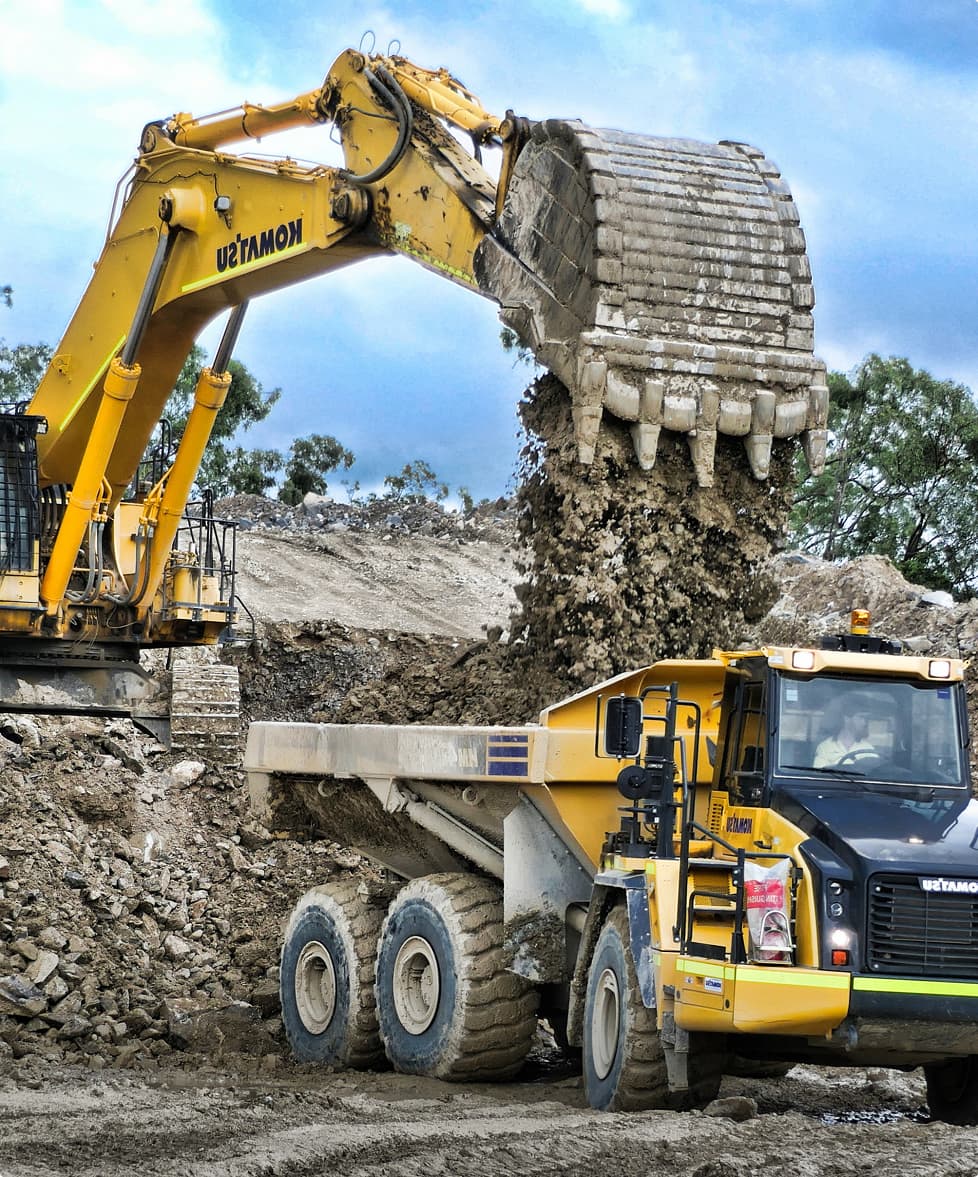
The FleetHire module was designed for operators who own and run assets and put some of them out on hire. This is the other setup: hire is the operation, the yard is the product, and utilisation is the number that decides whether the year works. The platform is the same, but the configuration and the emphasis change. Availability and turnaround matter more than job costing. Damage on return matters more than driver behaviour. The gear coming back is the event the whole business turns on, not an afterthought at the end of a project.
Where this fits, and where a rental ERP is the better answer
Being honest about this saves everyone a demo. TFO Software is the operations and fleet layer of a hire business: the asset register, availability, on and off hire status, servicing, condition records, tracking, delivery and utilisation, with hire quotes, contracts, rates and invoicing on top and a direct integration to Xero for the books. It is not a rental ERP. If you need a trade counter with a till and retail consumables, parts inventory with bin locations and supplier purchase orders, or general ledger and debtor management inside the same product, the enterprise rental platforms do that and TFO Software does not pretend to. What you get instead is a system that treats the machines as machines, supported by a team in Australia, without an implementation that runs for a year.
Availability you can commit to on the phone
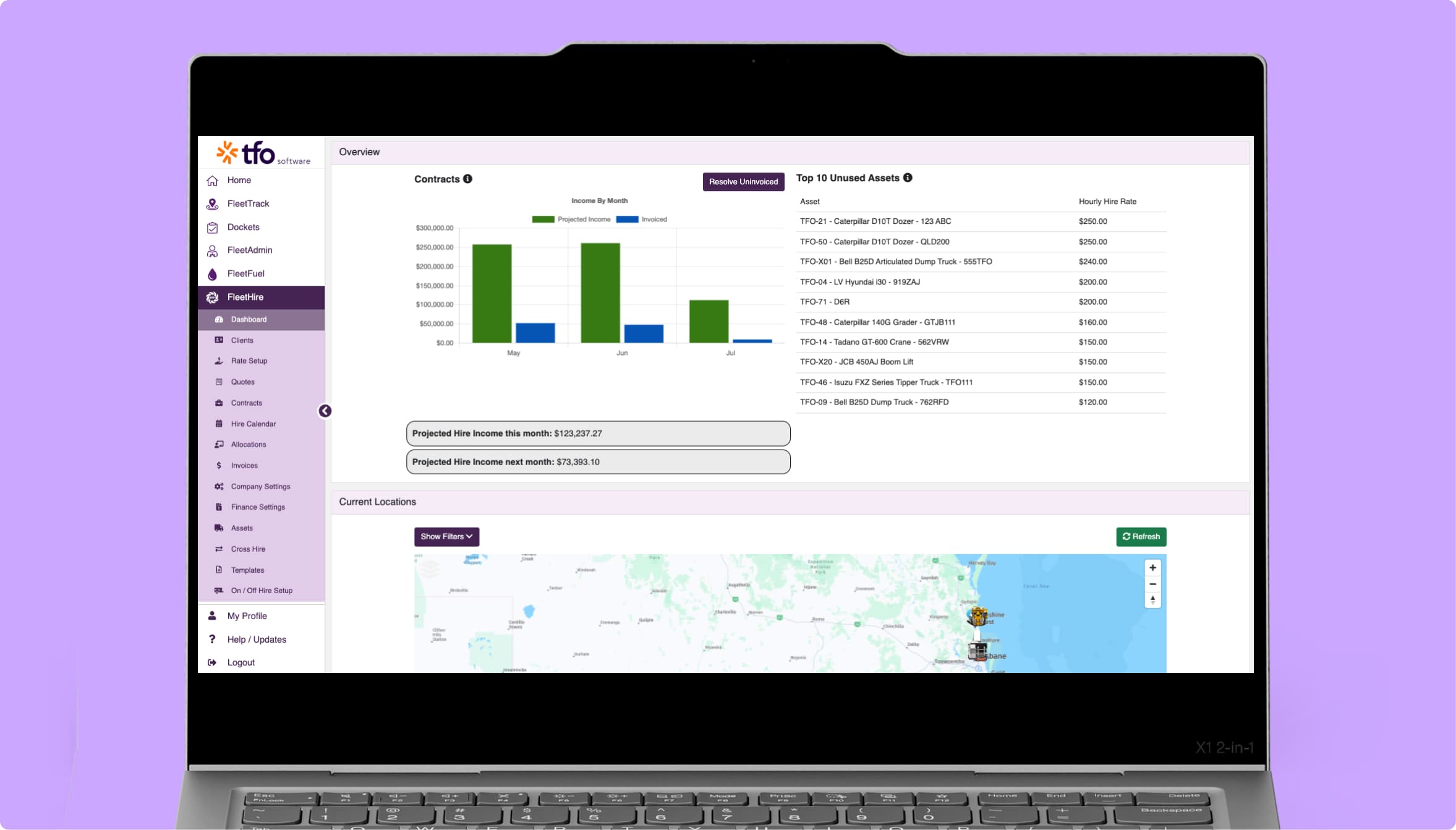
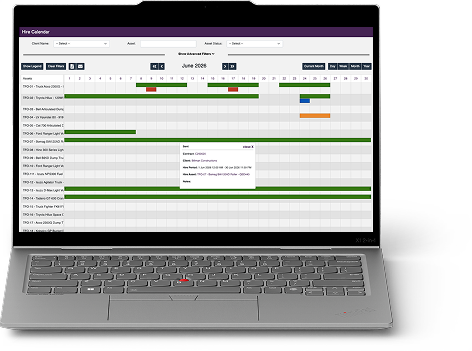
The Hire Calendar shows live availability across the yard, so when a customer asks for a five tonne excavator on Monday you either commit knowing it is free or offer a real date instead of a guess. Every item carries a status you can trust: on hire, off hire or in service. Filter by asset type, site or status to cut the yard down to the question you are actually answering, and add cross hired assets so gear you have hired in sits on the same board as your own. A four hundred dollar tool and a four hundred thousand dollar machine get the same discipline, which is the only way tool hire ever stays accountable.
Dry hire and wet hire in the same system
Dry hire tracks the asset, the period, the rate and the return. Wet hire is managed through allocations, where the machine, the operator and the hours worked are linked on one record. Most hire software handles one of these properly and bolts the other on. Keeping both in the same platform matters because the moment you supply an operator you are also supplying a timesheet, a docket and a duty of care, and those records need to sit against the same machine as the hire itself.
A machine in the workshop is a machine not earning
Every competitor sells maintenance as compliance or uptime. In a hire business it is simpler than that: an unserviced machine is unsellable inventory. FleetMaint sets the service interval per asset and counts it down on live utilisation rather than a calendar date, which matters when a machine’s hours depend entirely on who hired it and what they did with it. When tracking is fitted, the hours triggering the reminder come off the machine rather than off a yard hand’s estimate. A machine flagged for service will not be offered out on hire while it is in the workshop, so the availability board and the service board cannot drift apart.
Knowing which gear actually earns
The most expensive machine in a hire fleet is the one nobody can find, and the second most expensive is the one that never goes out. Because hire status, service status, location and cost all sit on one asset record, utilisation stops being a feeling about which machines are busy and becomes something you can look at per asset and per class before you buy another one. Hire charges and asset costs flow into Xero automatically. For Jonas, Baseplan, Viewpoint and VisionLink, data can be exported and imported instead.
The duty that comes with hiring plant out
Supplying plant is a regulated act, not just a commercial one. Safe Work Australia sets out the duties that apply to anyone who supplies plant, including ensuring the plant is without risks so far as is reasonably practicable and obtaining and passing on information about its proper use and risks. For second-hand plant there are further duties to identify faults and tell the buyer about them. In practice that means the record matters: what condition the machine went out in, what came back, what was rectified and when it was last inspected. Pre-hire and post-hire condition checks are completed on a phone with photos attached, time-stamped against the specific asset, and every service, defect and repair stays on that machine’s history permanently. Documents live on the asset record too, and each asset carries its own QR code, so the operator standing in front of the machine can scan it and pull up the documentation rather than ringing the office.
The delivery leg is part of the margin
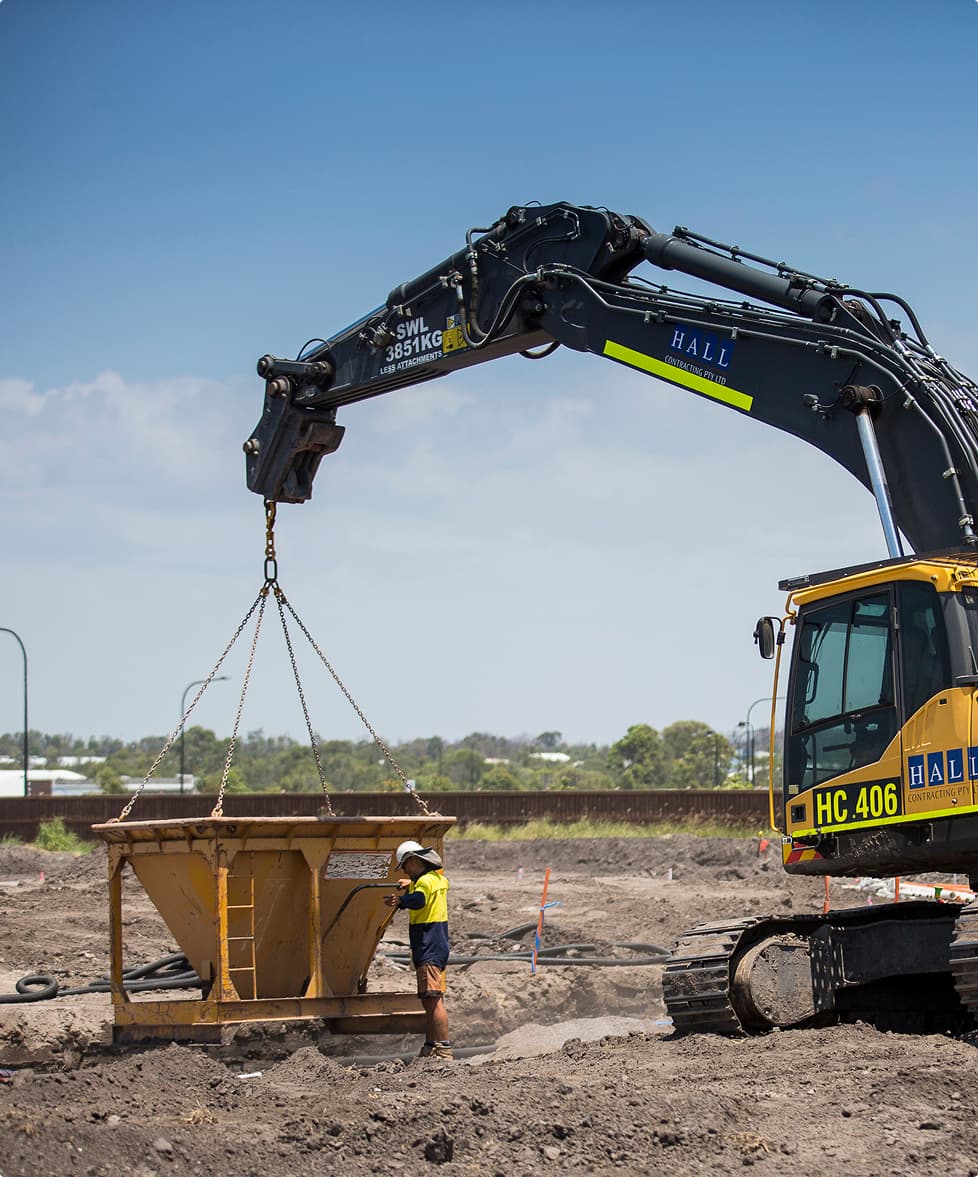
Most hire software treats transport as a scheduling feature. It is a cost centre. The float and the truck taking a machine out are assets in the same register, tracked on the same map, serviced on the same schedule and fuelled out of the same fuel records, so the cost of getting gear to site stops being invisible. Delivery and pickup dockets are built in the Digital Dockets form builder to match the ones your drivers already use, capturing quantities, condition, damage and a signature at the point of delivery, and landing in the system before the paper would have reached the office. Where you are carting plant yourself, the load restraint obligations sit with you as a party in the chain, and the docket and induction records are the evidence behind them.
Australian built, and it speaks plant hire
TFO Software is developed in-house in Mooloolaba, Queensland, by the team that supports it, and the hardware is supplied and supported by the same business rather than resold. Plenty of hire operators end up on overseas platforms built for the US market, where the language is rental and the workflows do not quite fit. This one uses dry hire, wet hire and plant because that is what the yard calls them. The platform is modular, priced on a tiered base according to the number of assets in your system, with no lock-in contracts and support included. You can load your own yard and watch a fortnight of on and off hire move through it on a 14-day free trial before committing.
Frequently Asked Questions
Still Got questions?
Is this different from the FleetHire module?
It is the same platform configured differently. FleetHire is built for operators who own and run a fleet and put some assets out on hire. This setup is for businesses where hire is the whole operation, so availability, turnaround, condition on return and utilisation carry more weight than job costing.
Can it handle tool hire as well as major plant?
Yes. Every item, whether it is an attachment, a hand tool or a thirty tonne excavator, carries a hire status and sits on the same availability board, so the whole yard is committed from one screen rather than from separate lists.
Does it handle both dry hire and wet hire?
Yes. Dry hire tracks the asset, period, rate and return. Wet hire is managed through allocations, linking the machine, the operator and the hours worked on one record.
Can we track gear we have hired in from another yard?
Yes. Cross hired assets can be added so hired-in equipment sits on the same availability board as your own, rather than being tracked separately and forgotten.
Does it replace our accounting system?
No. There is a direct integration with Xero, so hire charges and asset costs flow into the books you already run. For Jonas, Baseplan, Viewpoint and VisionLink, data can be exported and imported. If you use a different package, ask the team during your trial whether an integration is available.
Can we see where a machine is when a customer gets vague about it?
Yes, where the asset is fitted with tracking. Location sits on the same record as hire status and service status, so a unit that is off hire on paper but has not come back can be found rather than chased.


- Book your demo
- Or claim your 14-day Trial
Put your yard, your availability and your servicing in one system.
Book a demo or start a 14-day free trial and watch a fortnight of on and off hire run through it.